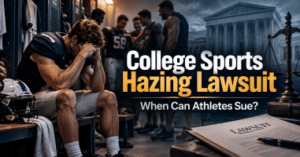
College athletes expect demanding practices, competition for playing time, and pressure to perform.
They should not have to accept assault, sexual abuse, forced nudity, dangerous drinking, humiliation, or other abusive conduct as the price of joining a team.
A college sports hazing lawsuit may be possible when an athlete suffers physical, sexual, psychological, or financial harm because of hazing, and another athlete, coach, university employee, or institution may be legally responsible.
The important distinction is that ordinary athletic demands are not the same thing as hazing.
Hard conditioning may be part of a sport. Being required to practice, travel, follow team rules, or compete for a roster position is generally not hazing by itself.
The analysis changes when someone is required or pressured to participate in degrading, dangerous, sexualized, abusive, or otherwise unlawful conduct because of their membership or status on a team.
Depending on what happened, a college sports hazing case may involve:
- assault or battery;
- sexual assault;
- negligence;
- negligent supervision;
- negligent retention;
- state hazing laws;
- Title IX;
- intentional infliction of emotional distress;
- premises or institutional liability;
- retaliation;
- other state or federal claims.
The athlete may have claims against the people who directly participated in the hazing.
In some cases, the larger question is whether the university or athletic department knew—or legally should have known—that athletes were being endangered and failed to act appropriately.
Athletes and families can also review Ben Crump Law’s broader guide to university hazing, sex abuse, and sexual assault lawsuits for additional information about campus abuse claims.
What Is College Sports Hazing?
College sports hazing generally involves abusive or dangerous conduct connected to joining, remaining on, or gaining status within an athletic team.
The conduct may be described as:
- initiation;
- tradition;
- rookie treatment;
- team bonding;
- punishment;
- earning respect;
- locker-room culture.
The label does not determine whether the conduct is acceptable or lawful.
In 2024, Congress enacted the Stop Campus Hazing Act, which expanded federal requirements for campus hazing disclosure and prevention. The law defines hazing broadly to include intentional, knowing, or reckless conduct associated with joining, affiliating with, or maintaining membership in a student organization that creates a risk of physical or psychological injury beyond the ordinary risks of participation. Athletic teams are included within the covered student-organization framework. (Stop Campus Hazing Act) GovInfo
What Can College Sports Hazing Look Like?
Hazing can take many forms.
Examples may include forcing or pressuring athletes to:
- consume excessive alcohol;
- endure beatings or paddling;
- perform dangerous physical tasks;
- undergo sleep deprivation;
- eat or drink disgusting substances;
- strip naked;
- perform sexually humiliating acts;
- submit to unwanted touching;
- simulate sexual activity;
- participate in forced sexual conduct;
- tolerate threats;
- endure racist or degrading treatment;
- perform humiliating acts in front of teammates;
- remain silent about abuse;
- participate in hazing younger teammates.
Some conduct may constitute hazing even if the athlete is never hospitalized.
Psychological humiliation and sexual abuse can cause serious harm without leaving obvious physical injuries.
Does the Athlete Have to Be a Freshman?
No.
Hazing is commonly associated with freshmen or rookies, but the issue extends beyond class year.
An athlete might be targeted because they are:
- new to the program;
- returning from an injury;
- competing for playing time;
- considered an outsider;
- younger than teammates;
- unwilling to participate in team rituals;
- viewed as disloyal for reporting misconduct.
The central issue is the abusive conduct and its connection to team membership or status.
Can Hazing Be Sexual?
Yes.
Sexualized hazing can be among the most serious forms of team abuse.
Possible examples include:
- forced nudity;
- unwanted genital touching;
- simulated sexual acts;
- forced sexual contact;
- penetration;
- sexually degrading rituals;
- sexual threats;
- photographing or recording someone during sexualized hazing.
Conduct described by teammates as a “joke” or “tradition” can still potentially constitute sexual assault or another civil wrong.
For athletes facing this kind of conduct, the fifth article in this series—Can a University Be Liable for Sexual Hazing by Teammates?—will focus specifically on when teammate misconduct may create potential institutional responsibility.
What Happened at New Mexico State?
The New Mexico State University men’s basketball program provides a recent example of how sexualized hazing can become an institutional issue.
The New Mexico Department of Justice investigated incidents during the 2022–23 season and reported a months-long pattern of sexualized hazing targeting teammates and student managers. The state investigation also identified what it described as systemic institutional failures that allowed the misconduct to go unaddressed. (New Mexico Department of Justice) New Mexico Department of Justice
That distinction matters.
A college hazing lawsuit may begin with the actions of individual players but expand into questions such as:
- What did coaches know?
- What did athletic administrators know?
- Were warning signs ignored?
- Were earlier complaints made?
- Did the university adequately investigate?
- Were accused athletes allowed to continue participating?
- Did the institution have effective reporting procedures?
Can an Athlete Sue a Teammate Who Participated in Hazing?
Potentially.
A student-athlete who personally participates in harmful conduct may face individual liability under state law.
Depending on the conduct, claims might include:
- assault;
- battery;
- sexual assault;
- intentional emotional harm;
- negligence;
- violations of state hazing laws.
The conduct can also result in a criminal investigation.
A criminal prosecution and a civil lawsuit are separate matters.
A victim does not necessarily have to wait for a criminal conviction before discussing civil options with an attorney.
Can the University Be Sued?
Potentially.
But a university is not automatically responsible for every harmful act committed by one student against another.
Institutional liability usually requires a legal basis connecting the university to the harm.
That is why one of the most important questions in these cases is often:
What did the university know, and what did it do about it?
Our companion article Can College Athletes Sue a University for Hazing? will focus more deeply on institutional liability.
Potential evidence may involve:
- prior hazing complaints;
- coach knowledge;
- athletic-department communications;
- Title IX reports;
- complaints from parents;
- team messages;
- prior disciplinary incidents;
- reports from trainers;
- injuries associated with hazing;
- anonymous complaints;
- prior lawsuits.
What if Coaches Knew About the Hazing?
That can be extremely important.
Suppose players repeatedly tell an assistant coach:
“Older teammates are sexually assaulting freshmen during initiation.”
The coach dismisses the report as team tradition.
The conduct continues.
Those facts may raise significant questions about:
- notice;
- supervision;
- institutional response;
- foreseeability;
- Title IX obligations where applicable.
Ben Crump Law previously filed lawsuits on behalf of former Northwestern football players alleging physical, sexual, and emotional hazing. One complaint alleged that coaches witnessed or failed to stop hazing and forced sexual conduct. Ben Crump
Readers can review Ben Crump Law’s coverage of the Northwestern University hazing lawsuit involving Lloyd Yates for an example of the allegations raised in college-athlete litigation.
What if the Head Coach Says They Did Not Know?
That can be a central factual question.
Knowledge should be proven rather than assumed.
An investigation may examine:
- whether athletes complained;
- who received complaints;
- whether assistant coaches knew;
- how long the hazing allegedly existed;
- where it happened;
- how common it was;
- whether team leaders openly discussed it;
- whether staff saw injuries or behavioral changes;
- whether administrators received reports.
An institution can have a serious hazing problem without automatically proving that every coach knew about it.
That distinction matters legally.
What About Assistant Coaches, Trainers, or Athletic Staff?
Knowledge may extend beyond the head coach.
Potentially relevant university employees can include:
- assistant coaches;
- graduate assistants;
- athletic trainers;
- strength coaches;
- team physicians;
- athletic directors;
- student-affairs personnel;
- Title IX personnel.
A lawyer may investigate who knew what, when they knew it, and what authority they had to respond.
What if the Hazing Was a Longstanding Team Tradition?
That can be important evidence.
A practice allegedly passed from one class of players to the next for years may raise different questions from one spontaneous incident involving two athletes.
A lawyer may investigate:
- how long the ritual existed;
- how many athletes participated;
- whether team captains organized it;
- whether coaches were nearby;
- whether previous athletes reported it;
- whether staff knew its nickname or purpose;
- whether earlier injuries occurred.
A longstanding practice may support an argument that the conduct was foreseeable.
But duration alone does not automatically establish university knowledge.
What Happened at Northwestern?
Ben Crump Law represented former Northwestern student-athletes who alleged sexual, physical, and emotional abuse associated with hazing in the university’s athletic program.
One lawsuit filed by former football player Simba Short alleged frequent locker-room harassment, unwanted physical and sexual contact, degrading treatment, and serious psychological harm. The complaint alleged that Northwestern and members of its athletic staff failed to protect athletes from foreseeable hazing and abuse. Ben Crump
Another Ben Crump Law case involved a former player who alleged he was only 17 when he experienced sexually abusive hazing. Ben Crump
Ben Crump Law also announced representation of multiple former Northwestern athletes alleging physical, sexual, and emotional abuse. Ben Crump
Those allegations provide direct experience relevant to the kinds of questions that can arise in college sports hazing cases.
Can an Athlete Sue Under Title IX?
Potentially, particularly when hazing involves sex-based harassment or sexual violence.
Title IX prohibits sex discrimination in education programs or activities receiving federal financial assistance.
Sexual harassment or sexual assault can potentially fall within Title IX when the legal requirements are met.
A university is not automatically liable whenever one student sexually assaults another.
Institutional Title IX liability can involve demanding standards concerning:
- actual knowledge;
- who had noticed;
- the school’s response;
- whether the conduct was sufficiently serious;
- the relationship between the misconduct and the educational environment.
A college sports hazing lawyer can evaluate whether Title IX, state tort law, hazing statutes, or another legal theory better fits the facts.
What if the Hazing Was Not Sexual?
A lawsuit still may be possible.
Nonsexual hazing may involve:
- dangerous drinking;
- assault;
- physical punishment;
- extreme exercise;
- food deprivation;
- sleep deprivation;
- forced exposure to dangerous conditions;
- humiliation;
- threats.
Potential claims may arise under state negligence, assault, battery, hazing, or other laws.
The applicable theory depends on the state and circumstances.
Can Forced Drinking Lead to a Hazing Lawsuit?
Potentially.
Alcohol-related hazing can result in:
- alcohol poisoning;
- loss of consciousness;
- falls;
- aspiration;
- brain injury;
- organ damage;
- death.
Important questions may include:
- Who supplied the alcohol?
- Was participation coerced?
- Did team leaders organize the activity?
- Were coaches or staff aware?
- Was medical care delayed?
- Had similar rituals occurred previously?
State anti-hazing laws may also create specific duties or remedies.
What if the Athlete Agreed to Participate?
Consent does not always resolve the issue.
College athletes can face intense pressure to conform.
An athlete may believe refusal could lead to:
- exclusion from teammates;
- lost playing time;
- humiliation;
- retaliation;
- loss of team status;
- loss of friendships;
- being labeled weak.
State hazing laws may also limit the relevance of purported consent.
The legal effect varies by jurisdiction and conduct.
Sexual assault raises additional consent issues.
What if “Everyone on the Team Went Through It”?
That does not necessarily make the conduct lawful.
A practice can be widespread and still be abusive.
In fact, repetition can become relevant to institutional knowledge.
If every incoming class experiences the same ritual, investigators may ask:
How could this continue for years without anyone in authority knowing?
That question still requires evidence.
But “tradition” is not a legal defense by itself.
What if the Athlete Also Hazed Younger Teammates Later?
That can complicate a claim.
A victim may later participate in the same culture.
That does not necessarily erase what happened to them.
Hazing systems can pressure victims into becoming participants.
However, later conduct can affect:
- credibility;
- defenses;
- comparative fault issues;
- potential liability to other victims.
A lawyer should know the complete history.
Can Athletes Be Retaliated Against for Reporting Hazing?
They may experience retaliation such as:
- reduced playing time;
- exclusion from team activities;
- threats;
- loss of leadership roles;
- hostile treatment;
- pressure to transfer;
- loss of opportunities.
Whether that creates a separate legal claim depends on which laws apply.
Title IX contains protections against retaliation for reporting sex discrimination where its requirements are met.
State laws or university policies may provide additional protection.
Athletes should preserve evidence of any treatment that changes after a report.
What Evidence Can Help Prove College Sports Hazing?
These cases can involve extensive digital evidence.
Useful evidence may include:
- text messages;
- group chats;
- team messaging apps;
- videos;
- photographs;
- social-media posts;
- emails;
- athletic department reports;
- Title IX complaints;
- coach communications;
- medical records;
- witness statements;
- disciplinary records;
- team handbooks;
- anti-hazing policies.
A ritual that athletes thought was secret may leave a substantial digital trail.
Are Team Group Chats Important?
Often.
Chats may show:
- plans for initiation;
- instructions to freshmen;
- warnings not to tell coaches;
- names of participants;
- photographs;
- jokes about previous hazing;
- threats;
- discussions after someone reports abuse.
Preserve complete conversations when lawfully available.
Do not delete or edit messages.
Screenshots can help, but original records and metadata may sometimes provide stronger evidence.
What About Snapchat or Disappearing Messages?
Disappearing messages can make preservation harder.
Other evidence may still exist through:
- screenshots;
- recipients;
- device records;
- cloud backups where available;
- witnesses;
- related messages on other platforms.
Do not attempt to access someone else’s account without authorization.
A lawyer can evaluate lawful preservation and discovery methods.
What if Someone Recorded the Hazing?
Video can be powerful evidence.
It may establish:
- who was present;
- what happened;
- whether participation appeared voluntary;
- whether someone objected;
- whether teammates laughed or encouraged it;
- severity of the conduct.
Preserve the original file.
Do not edit it or add effects.
What Medical Records Can Matter?
Hazing may cause:
- fractures;
- bruising;
- head injuries;
- sexual injuries;
- alcohol poisoning;
- anxiety;
- depression;
- trauma symptoms;
- other psychological injuries.
Relevant medical evidence may include:
- emergency-room records;
- primary-care records;
- counseling records;
- psychiatric treatment;
- prescriptions;
- photographs.
Treatment should be pursued because it is medically appropriate, not simply to document a lawsuit.
Can Psychological Trauma Support a Lawsuit?
Potentially.
Sexualized and humiliating hazing can cause serious psychological harm.
Possible effects include:
- anxiety;
- depression;
- nightmares;
- shame;
- panic attacks;
- difficulty concentrating;
- loss of trust;
- withdrawal from sports;
- post-traumatic symptoms.
One Ben Crump Law Northwestern lawsuit alleged continuing severe psychological effects associated with sexualized hazing and abuse. Ben Crump
What if the Athlete Quits the Team?
Leaving the team does not necessarily eliminate legal options.
Quitting may itself be part of the harm.
An athlete may lose:
- athletic opportunity;
- scholarship benefits;
- education opportunities;
- professional development;
- team relationships;
- future sports prospects.
Whether those losses are legally recoverable depends on causation and applicable law.
What if the Athlete Transfers?
A transfer can also create consequences.
Potential losses may include:
- lost credits;
- delayed graduation;
- relocation costs;
- scholarship changes;
- athletic eligibility complications;
- loss of playing time.
Document the reason for the transfer and associated costs.
Can Losing an Athletic Scholarship Be Part of Damages?
Potentially.
If hazing or retaliation causes an athlete to lose scholarship assistance, that economic loss may be relevant.
Records may include:
- scholarship agreements;
- tuition bills;
- financial-aid documents;
- athletic department communications.
Causation is important.
The athlete must connect the loss to the legally actionable conduct.
What Compensation May Be Available?
Depending on the case, possible damages may include:
- medical expenses;
- future treatment;
- psychological care;
- lost educational costs;
- lost scholarship value;
- other economic losses;
- pain and suffering;
- emotional distress;
- damages associated with sexual assault;
- punitive damages where permitted;
- other state or federal remedies.
The third article in this cluster—College Sports Hazing Settlement—will focus specifically on potential compensation and settlement terms.
Can a Settlement Require Changes to an Athletic Program?
Potentially.
Hazing cases may involve non-monetary relief such as:
- new anti-hazing policies;
- training;
- independent reporting systems;
- athletic-department monitoring;
- disciplinary changes;
- Title IX reforms;
- improved complaint procedures.
Congress’s Stop Campus Hazing Act also created new federal transparency and prevention requirements for covered colleges, including hazing statistics, policies, prevention programming, and campus hazing transparency reports. (Stop Campus Hazing Act) GovInfo
Does the Stop Campus Hazing Act Automatically Let an Athlete Sue?
Not necessarily.
The federal statute strengthens campus hazing reporting and prevention.
That does not mean every violation automatically gives rise to a private damages lawsuit under the Act.
A victim’s civil claims may instead rely on:
- state hazing laws;
- negligence;
- assault or battery;
- sexual-assault law;
- Title IX;
- other applicable causes of action.
A lawyer should identify the actual legal basis for the claim rather than simply citing the federal law.
Why Are University Hazing Records More Important Now?
Federal law now requires greater transparency concerning hazing incidents at covered institutions.
That can make institutional history more important.
A lawyer investigating a new case may examine:
- campus hazing transparency reports;
- annual security information;
- disciplinary findings;
- historical reports;
- university policies.
Evidence of earlier hazing incidents can be relevant to questions of notice and foreseeability.
What If the University Investigated and Punished the Students?
That may affect institutional liability.
A university that receives a report and responds promptly and effectively may present a different legal case from one that:
- ignores the complaint;
- minimizes the conduct;
- protects prominent athletes;
- discourages reporting;
- leaves alleged perpetrators in positions to continue the behavior.
The reasonableness and adequacy of the response depend on the applicable legal theory.
What if the University Suspended the Team?
That may help prevent additional misconduct.
It does not necessarily resolve harm that has already occurred.
A victim may still have damages involving:
- physical injury;
- sexual trauma;
- psychological treatment;
- education disruption;
- lost athletic opportunity.
Corrective action after the fact can matter, but it does not erase earlier injury.
What if Coaches Ordered Players to Keep Quiet?
That could be significant evidence.
Statements such as:
“Handle this inside the team.”
“Don’t embarrass the program.”
“If this gets reported, everyone loses.”
may support arguments involving:
- notice;
- concealment;
- retaliation;
- institutional culture.
Write down the exact language, speaker, date, and witnesses if possible.
What if the Athlete Is Afraid of Losing Playing Time?
That fear can be very real.
College athletes may depend on coaches for:
- scholarships;
- playing time;
- recommendations;
- transfer opportunities;
- professional exposure.
Those power dynamics can discourage reporting.
An athlete’s delay in reporting therefore, does not automatically mean the allegation is false.
The reasons for the delay should be examined.
What if the Athlete Was a Minor?
That can create additional legal considerations.
Some college athletes enter programs at age 17.
Claims involving sexual conduct against minors may implicate:
- child sexual abuse statutes;
- special limitation periods;
- mandatory-reporting issues;
- additional state-law protections.
Ben Crump Law previously filed a Northwestern-related case alleging that a former football player was first sexually abused during hazing while he was a 17-year-old freshman. Ben Crump
Are Hazing Laws the Same in Every State?
No.
State hazing laws vary substantially.
Differences may involve:
- definition of hazing;
- criminal penalties;
- civil remedies;
- duties imposed on institutions;
- consent;
- reporting;
- limitations periods.
A case must be evaluated under the law of the state where the conduct occurred.
How Long Does an Athlete Have to Sue?
There is no single nationwide deadline.
Possible limitation periods may depend on:
- negligence;
- assault;
- sexual abuse;
- Title IX;
- state hazing statutes;
- the athlete’s age;
- discovery rules;
- whether a public university is involved.
Claims against public universities may also involve special notice or sovereign-immunity issues.
Prompt legal review is important.
Does It Matter Whether the University Is Public or Private?
Yes.
Public and private universities can present different legal issues.
A public institution may raise:
- sovereign immunity;
- state claims acts;
- shortened notice periods;
- constitutional issues.
A private university may present different contractual or tort theories.
Title IX applies to educational institutions that receive federal financial assistance, whether public or private.
Should an Athlete Report Hazing to the University?
Reporting may create an important record and may help stop ongoing harm.
Possible reporting channels include:
- Title IX office;
- athletic director;
- student affairs;
- campus safety;
- university ethics hotline;
- coach or administrator.
But immediate safety comes first.
Sexual assault, serious injury, or threats may also warrant medical care or law-enforcement involvement.
A lawyer can help an athlete understand how internal reporting may interact with potential litigation.
Should an Athlete Delete Team Chats After Leaving?
No.
Preserve potentially relevant evidence.
Do not delete:
- team messages;
- texts;
- videos;
- photos;
- emails;
- reporting records.
Likewise, do not alter evidence or encourage teammates to coordinate stories.
Should an Athlete Post the Allegations on Social Media?
Use caution.
Public accusations can complicate:
- university investigations;
- criminal cases;
- civil litigation;
- witness testimony.
Preserve evidence and seek appropriate advice before turning a legal matter into a social-media dispute.
What Makes a College Sports Hazing Case Worth Investigating?
No single fact proves liability.
A case may deserve closer review when several circumstances appear together:
- physical or sexual abuse occurred;
- participation was coerced;
- older athletes organized the conduct;
- the hazing was longstanding;
- coaches or staff knew;
- earlier complaints existed;
- the university failed to respond;
- serious injury occurred;
- athletes were threatened with retaliation;
- digital evidence exists;
- other former players describe similar experiences.
What Facts Can Make the Case Harder?
Potential challenges may include:
- weak evidence of what occurred;
- conflicting witness accounts;
- no evidence connecting the university to the misconduct;
- prompt and effective university response;
- procedural filing problems;
- expired limitation periods;
- public-university immunity issues;
- difficulty proving damages.
A proper evaluation should address those issues rather than assuming every harmful team incident creates university liability.
College Sports Hazing: A Useful Evidence Timeline
An athlete might reconstruct:
August: Joins team.
September: Older players describe an initiation ritual.
September 14: Hazing occurs.
September 15: Athlete tells teammate what happened.
September 18: Athlete texts assistant coach.
September 20: Coach says the team should handle the issue internally.
October: Hazing continues.
November: Athlete seeks counseling.
December: Athlete reports to the athletic department.
A chronology can reveal when the university received notice and how it responded.
How This College Sports Hazing Cluster Will Be Internally Linked
This five-article cluster will target different stages of the athlete’s legal search while intentionally connecting the pages.
1. College Sports Hazing Lawsuit
Current page.
Focus: When can hazing potentially become a civil case?
It links readers to the four narrower pages below.
2. College Sports Hazing Lawyer
Focus: How can an attorney investigate coaches, university knowledge, Title IX records, prior hazing, team messages, witnesses, and damages?
3. College Sports Hazing Settlement
Focus: What compensation and non-monetary relief may be available after physical, sexual, or psychological hazing?
4. Can College Athletes Sue a University for Hazing?
Focus: When can responsibility extend beyond individual teammates to the school or athletic department?
5. Can a University Be Liable for Sexual Hazing by Teammates?
Focus: How can sexualized teammate abuse create potential Title IX, negligence, sexual assault, or institutional liability issues?
I’ll continue embedding these contextual links inside each article, rather than leaving the cluster connection to a separate linking step later.
Talk With Ben Crump Law About College Sports Hazing
Athletes should not have to choose between enduring abuse and losing the sport, scholarship, teammates, or educational opportunities they worked to earn.
Ben Crump Law has represented former Northwestern student-athletes alleging physical, sexual, and emotional hazing and abuse. Ben Crump
If you or a loved one suffered sexual abuse, physical assault, dangerous initiation practices, psychological abuse, or another serious form of hazing within a college athletic program, the circumstances may warrant legal review.
A college sports hazing lawyer can investigate the conduct itself, what coaches and university administrators knew, how the institution responded, whether Title IX or state hazing laws may apply, and what compensation or other remedies may be available.
Contact Ben Crump Law at +1 (800) 683-5111 for a free, confidential consultation.