Families may be able to obtain independent expert reviews, preserve evidence, seek records, and investigate potential civil claims when important questions remain after a death
When someone dies unexpectedly, and the official investigation does not provide clear answers, surviving family members may wonder whether they have any ability to investigate further.
Depending on the circumstances, they may.
An official law enforcement investigation or medical examiner’s findings are not always the only sources of information available after an unexplained death. Families may be able to retain attorneys, forensic pathologists, digital-forensics specialists, investigators, medical experts, or other professionals to independently review evidence and determine whether additional questions should be pursued.
An independent investigation does not mean that wrongdoing necessarily occurred.
Its purpose is to determine what the available evidence actually shows, identify information that may have been overlooked or remains unavailable, preserve evidence before it is lost, and evaluate whether additional civil or governmental action may be appropriate.
Those issues have received renewed attention following developments in the death of 18-year-old Nolan Wells, whose family retained independent experts while continuing to seek answers about what happened to him after a July 4 trip to Horn Island, Mississippi.
What Is an Independent Death Investigation?
An independent death investigation is a review conducted outside the original governmental investigation.
Depending on the case, it may involve:
- reviewing autopsy and medical records;
- obtaining an independent forensic pathology opinion;
- conducting or reviewing a second autopsy;
- analyzing photographs and videos;
- reviewing police reports and investigative records;
- examining witness statements;
- locating additional witnesses;
- reconstructing timelines;
- preserving physical evidence;
- analyzing cell phones and other electronic devices;
- reviewing location and GPS information;
- examining text messages and social media activity;
- consulting accident-reconstruction, medical, or other experts; and
- evaluating whether the evidence may support a civil claim.
The scope depends entirely on the circumstances surrounding the death.
Some cases primarily involve medical evidence. Others may rely heavily on digital records, surveillance footage, witness testimony, law enforcement records, or physical evidence.
Why Might a Family Seek an Independent Investigation?
Families may seek independent review when the official investigation leaves material questions unanswered.
Those questions might include:
- What actually caused the death?
- Was the death accidental, natural, suicidal, homicidal, or undetermined?
- Did an injury occur before death?
- Were all relevant witnesses interviewed?
- Are witness accounts consistent with physical evidence?
- Was surveillance or digital evidence preserved?
- Are there gaps in the known timeline?
- Was important forensic testing conducted?
- Were government agencies or other parties involved?
- Could negligence or another wrongful act have contributed to the death?
None of these questions proves wrongdoing.
But where important factual gaps remain, an independent investigation may help a family determine whether those gaps can be resolved.
Can a Family Obtain an Independent Autopsy?
In some circumstances, yes.
Families sometimes retain a forensic pathologist to conduct a second autopsy or independently review an existing autopsy and supporting records.
The feasibility and usefulness of a second examination can depend on timing, the condition of the remains, whether the body has been embalmed, whether another autopsy has already occurred, and the type of evidence at issue.
An independent forensic pathologist may review:
- the body and documented injuries;
- tissue samples;
- toxicology results;
- photographs;
- imaging;
- microscopic slides;
- the original autopsy report;
- emergency medical records;
- investigative reports; and
- other relevant evidence.
A second examination may confirm the original findings, identify additional issues, or determine that available evidence is insufficient to reach a definitive conclusion.
It should not be assumed that an independent autopsy will contradict the government’s findings.
The Nolan Wells Case Shows How Independent Forensic Review Can Work
The Nolan Wells investigation provides a recent example.
Wells disappeared after traveling by boat with friends to Horn Island on July 4, 2026. His body was recovered near the island two days later.
His family retained an independent forensic pathologist to examine his remains.
Ben Crump Law later announced preliminary findings from that independent autopsy.
The independent examiner reportedly classified the cause and manner of Wells’ death as undetermined. Mississippi’s medical examiner also reportedly classified the cause and manner as undetermined.
A Jackson County grand jury subsequently declined to indict anyone, concluding that the evidence presented did not establish criminal conduct and that the circumstances in which Wells’ body was found were consistent with drowning.
Those findings illustrate why different components of an investigation need to be understood separately.
A medical examiner evaluates forensic and medical evidence. A grand jury determines whether evidence justifies criminal charges. Neither process automatically resolves every possible civil question.
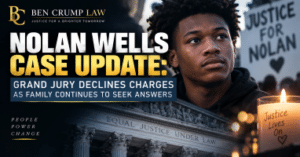
For the latest development, see Nolan Wells Case Update: Grand Jury Declines Charges as Family Continues to Seek Answers.
For a broader explanation of the legal significance of a no-indictment decision, see What Happens When a Grand Jury Declines Criminal Charges in a Death Investigation?.
Can a Family Review Cell Phone and Digital Evidence?
Digital evidence can be particularly important in unexplained-death investigations.
Cell phones and online accounts may contain information about a person’s movements, communications, plans, and interactions before death.
Potential sources of digital evidence may include:
- text messages;
- call records;
- photographs and videos;
- GPS and location history;
- app activity;
- social media communications;
- cloud backups;
- email;
- ride-sharing or transportation records;
- fitness-device data;
- vehicle data; and
- metadata associated with photographs or files.
Because digital data can be deleted, overwritten, lost, or retained only temporarily, preservation may become important early in an investigation.
In the Nolan Wells case, the family also sought a forensic examination of Wells’ phone.
The grand jury later reviewed digital and forensic evidence as part of its broader inquiry. According to current reporting, the grand jury issued 132 subpoenas and considered evidence including cellphone information, forensic reports, videos, and GPS data.
Why Is Evidence Preservation So Important?
Evidence often becomes more difficult to obtain as time passes.
Physical items can be lost or altered. Surveillance footage can be overwritten. Electronic records may be deleted. Witness memories can fade.
Families who believe additional investigation may be necessary may therefore want to identify potentially relevant evidence as early as possible.
Depending on the case, potentially important evidence may include:
- police body-camera footage;
- surveillance video;
- 911 recordings;
- dispatch records;
- medical records;
- autopsy materials;
- photographs;
- witness contact information;
- cell phones;
- social media records;
- location data;
- vehicle data;
- physical evidence;
- employment or institutional records; and
- electronically stored information.
An attorney may be able to send preservation notices, request records, pursue discovery if litigation begins, or use other legal procedures to seek evidence.
The available methods vary depending on who controls the information and whether litigation has been filed.
Can Families Obtain Police and Government Records?
Potentially.
Public records laws may provide access to certain government records, although exemptions frequently apply to active investigations, confidential information, medical records, personnel information, and other protected materials.
The rules vary substantially by jurisdiction.
An attorney may also obtain information through litigation-related discovery, subpoenas, court orders, or other legal processes, when available.
Families should not assume that every investigative record must automatically be released.
They also should not assume that an initial denial necessarily means the information can never be obtained.
The legal basis for obtaining a record depends on the jurisdiction, the type of record, the status of the investigation, and the nature of any pending litigation.
Can an Independent Investigator Interview Witnesses?
Yes, investigators retained by a family or its attorneys may attempt to locate and interview witnesses, subject to applicable laws and ethical rules.
Independent witness interviews can sometimes help identify:
- overlooked witnesses;
- differing timelines;
- inconsistencies between accounts;
- previously unknown photographs or videos;
- additional people present at a scene; or
- contextual information not included in an official report.
Independent investigators do not have the same powers as law enforcement.
They generally cannot compel someone to cooperate simply because they want to interview them.
If litigation proceeds, however, attorneys may have access to formal discovery tools that can require testimony or production of evidence under applicable procedural rules.
What If the Medical Examiner Says the Cause of Death Is Undetermined?
An undetermined finding does not necessarily mean an investigation is over.
It generally means the available evidence does not permit the examiner to classify the cause, manner, or both with sufficient confidence.
That may happen because of:
- decomposition;
- conflicting evidence;
- insufficient medical findings;
- incomplete investigative information;
- limitations created by an earlier examination;
- missing toxicology or laboratory information; or
- uncertainty about what occurred immediately before death.
An undetermined classification does not prove homicide, negligence, or any other form of wrongdoing.
But where important questions remain, families may choose to have qualified experts independently review the medical and investigative evidence.
Can a Family Investigate Even If Police Say There Was No Foul Play?
Potentially.
A law-enforcement conclusion that investigators do not suspect foul play is relevant, but it does not necessarily prevent a family from seeking its own expert review.
The family may want to determine whether independent evidence supports the government’s conclusion.
In some cases, the independent investigation confirms the official findings.
In others, it may identify additional questions that warrant further examination.
The objective should be evidence-based investigation rather than assuming in advance that official conclusions are either correct or incorrect.
Can a Family Continue Investigating After a Grand Jury Declines Charges?
Yes, depending on the available evidence and applicable law.
A grand jury’s decision addresses potential criminal charges.
An independent investigation may focus on broader questions, including the cause of death, negligence, civil liability, civil rights, evidence preservation, or whether additional information should be brought to the attention of governmental authorities.
The recent Nolan Wells grand jury report specifically stated that the matter could be presented again if credible evidence later suggests his death was non-accidental.
That does not mean the Wells case will necessarily return to a grand jury. It illustrates that a no-indictment decision does not always make future investigative developments legally impossible.
Can an Independent Investigation Lead to a Wrongful Death Lawsuit?
Potentially.
A wrongful death claim generally requires evidence that another person’s or entity’s legally actionable conduct caused or contributed to a death.
Depending on the jurisdiction and facts, that conduct may involve negligence or another recognized civil wrong.
An investigation may therefore examine:
- who owed a legal duty;
- whether that duty was breached;
- whether the breach caused the death;
- whether multiple parties may be responsible;
- whether evidence supports causation;
- who has legal standing to bring the claim; and
- what damages may be recoverable.
The absence of criminal charges does not automatically prevent a civil wrongful death case.
But an unexplained death does not automatically establish wrongful death liability either.
The evidence must support the legal elements of the claim.
Families who are trying to determine whether another party’s conduct may have contributed to a loved one’s death can learn more about working with a wrongful death lawyer.
What If Government Officials May Be Involved?
Cases involving police officers, correctional institutions, government agencies, or other state actors may raise additional legal questions.
Potential claims can involve constitutional rights, civil rights statutes, wrongful death law, negligence law, or other legal theories depending on the circumstances.
Government-related claims can also involve special procedural requirements, immunities, notice deadlines, and statutes of limitation.
For that reason, these cases may require prompt legal analysis.
Ben Crump Law represents individuals and families in civil rights matters, including cases involving alleged misconduct by government actors. Learn more about working with a civil rights lawyer.
Can the U.S. Department of Justice Conduct Its Own Investigation?
In some circumstances, federal authorities can investigate conduct that may violate federal law.
Federal jurisdiction is not created simply because a family disagrees with a local or state investigation.
There must be a potential federal legal basis for involvement.
In the Nolan Wells case, Wells’ family and legal team have repeatedly sought federal review.
Following the September 2026 grand jury decision, the family’s attorneys renewed their call for an independent federal investigation.
Whether federal authorities take additional action remains a separate determination.
How Can a Lawyer Help Investigate an Unexplained Death?
An attorney involved early in an unexplained-death investigation may be able to coordinate several different investigative functions.
Depending on the circumstances, that may include:
- identifying evidence that should be preserved;
- obtaining medical and investigative records;
- retaining forensic experts;
- coordinating an independent autopsy or pathology review;
- retaining investigators;
- locating witnesses;
- seeking digital evidence;
- evaluating potential defendants;
- determining whether governmental entities are involved;
- evaluating state and federal causes of action;
- monitoring statutes of limitation and notice deadlines; and
- communicating with government agencies or opposing parties.
Attorneys may also help families distinguish between questions that are emotionally compelling and facts that are legally relevant to a potential claim.
That distinction can be important when deciding what additional investigation is justified.
When Should a Family Contact an Attorney About an Unexplained Death?
Families do not necessarily need to wait until an official investigation is finished.
Waiting can sometimes create evidentiary problems.
Surveillance footage may disappear. Digital records may become unavailable. Witnesses can become difficult to locate. Statutory deadlines can continue running even while a criminal investigation remains open.
Early legal consultation can therefore help determine whether anything needs to be preserved immediately.
This does not mean every unexplained death requires litigation.
An attorney may ultimately conclude that the evidence does not support a civil claim.
But an early investigation can provide families with a clearer understanding of what evidence exists, what additional information may be obtainable, and what legal options are realistically available.
What Should Families Preserve After an Unexplained Death?
Families considering additional investigation should avoid altering or discarding potentially relevant information.
Depending on the circumstances, useful materials may include:
- the deceased person’s cell phone;
- computers and tablets;
- passwords or account-access information lawfully available to the family;
- text messages;
- emails;
- photographs and videos;
- social media communications;
- medical records;
- funeral-home records;
- names and contact information for witnesses;
- correspondence with police or government agencies;
- timelines created while events are still fresh; and
- copies of any investigative reports already obtained.
Families should also avoid modifying devices or accounts in ways that could change metadata or destroy potentially relevant information.
Forensic professionals may be able to create preserved copies of digital evidence before further review.
How Long Does a Family Have to Investigate a Possible Wrongful Death?
Deadlines vary by state and by the type of claim.
Wrongful death and civil rights claims are subject to statutes of limitation.
Claims involving government agencies may also be subject to separate notice requirements that can expire before the ordinary lawsuit deadline.
The applicable period may depend on:
- where the death occurred;
- who may be responsible;
- whether a governmental defendant is involved;
- the particular legal claim;
- when relevant facts were discovered; and
- other state or federal rules.
Because missing a deadline can prevent a claim from proceeding, families should not assume that an unresolved criminal investigation pauses every applicable civil deadline.
What Should a Family Do If Important Questions Remain?
When a death remains unexplained, the most useful first step is usually to identify exactly what is known, what remains unknown, and what evidence could answer those questions.
That can mean:
- preserving physical and digital evidence;
- obtaining available medical and investigative records;
- documenting the known timeline;
- identifying witnesses;
- obtaining qualified forensic review where appropriate; and
- consulting an attorney about potential investigative and legal options.
The objective is not to reach a predetermined conclusion.
It is to preserve the opportunity to determine what the evidence supports.
Talk to an Attorney About an Unexplained or Potentially Wrongful Death
Families should not have to rely on speculation when important questions remain about how a loved one died.
An independent legal investigation may help identify evidence, obtain expert review, preserve records, evaluate potential civil claims, and determine whether additional investigative avenues are available.
If your family is seeking answers after a suspicious, unexplained, or potentially wrongful death, Ben Crump Law can review the circumstances and explain what legal options may be available.
Learn more about wrongful death claims, review information about civil rights cases, or contact Ben Crump Law for a case evaluation.